
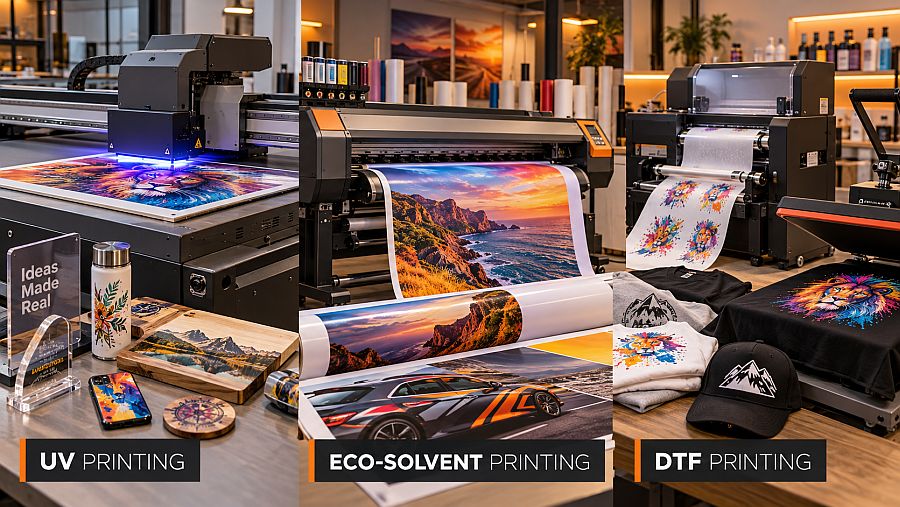
Digital printing has transformed the way businesses produce signage, promotional products, garments and customised merchandise. However, the term digital printing covers several technologies with significantly different operating principles and applications.
Three commonly encountered technologies are UV printing, eco-solvent printing and Direct-to-Film (DTF) printing. Although all three use digitally controlled inkjet processes, they differ in how their inks are applied, how the printed image is fixed to a surface and which materials they are best suited to decorating.
Understanding these differences is important when evaluating equipment, planning production processes or deciding how best to manufacture a particular product.
UV Printing: Printing Directly onto Surfaces
UV printing uses specially formulated inks that cure when exposed to ultraviolet radiation. In a typical UV inkjet system, droplets of ink are deposited onto a material and exposed to UV light, initiating a chemical curing process that forms a solid printed layer.
Unlike conventional solvent-based printing, the process does not primarily depend on the evaporation of a liquid carrier. This allows suitable UV inks to be applied to a wide variety of materials, including certain plastics, acrylic, wood, glass, coated metals and rigid boards.
UV printers are available in several configurations. Flatbed machines are commonly used for printing onto sheets, panels and relatively flat objects. Other designs accommodate roll-fed materials, cylindrical objects or products with specialised shapes.
Some UV printing systems also support white ink and clear varnish, enabling printing on transparent or dark materials and the creation of decorative textures.
The Advantages of UV Printing
One of UV printing’s principal strengths is its ability to decorate suitable rigid materials directly. For example, a printed image can be applied to an acrylic panel without first producing an adhesive graphic that must subsequently be mounted onto the surface.
The curing process also means that printed items can often be handled or processed immediately after printing.
Depending on the ink system and equipment, UV printing can produce opaque white layers, decorative gloss effects and raised textures. These capabilities make the technology useful for applications such as signage, display panels, product decoration and personalised merchandise.
The Limitations of UV Printing
Despite its versatility, UV printing is not universally suitable for every material. Ink adhesion depends on the chemical composition and surface characteristics of the substrate.
Two items that appear to be made from the same plastic may behave differently because of variations in their formulation, coatings or surface treatments. Certain materials require cleaning, surface preparation or a compatible primer before satisfactory adhesion can be achieved.
UV-cured ink also forms a layer on the material’s surface. Its flexibility and resistance to abrasion, chemicals and environmental exposure depend on the ink formulation and application. Printing onto flexible materials therefore requires an appropriately designed ink system.
Highly reflective surfaces can create additional difficulties. Reflected UV radiation may cause unwanted curing of ink near the printheads, while irregular or uneven surfaces can interfere with accurate ink placement. Consequently, material compatibility should be established through appropriate testing rather than assumed from a general list of printable substrates.
Eco-Solvent Printing: A Technology Built Around Flexible Media
Eco-solvent printing is widely associated with commercial signage and graphics production. It uses inks containing solvents that help the colourants interact with the surface of compatible printing media.
After printing, the solvent components evaporate, leaving the printed image on or within the receptive surface layer of the material. Eco-solvent printers are commonly configured as roll-fed machines designed to process flexible media.
Typical applications include adhesive vinyl graphics, banners, posters, labels, vehicle graphics and certain decorative films. Some systems combine printing and contour cutting, allowing graphics to be printed and then cut into their required shapes.
The Advantages of Eco-Solvent Printing
Eco-solvent technology is particularly well suited to producing graphics on compatible flexible materials. Adhesive vinyl can be printed, cut and applied to signs, windows, vehicles or other surfaces.
Large-format printers can produce substantial lengths of graphics using roll-fed media, making the technology useful for both individual jobs and repeat production. Suitable ink and media combinations can also provide good outdoor durability. However, durability is not determined by the ink alone.
The media, environmental conditions, installation method and any protective laminate all contribute to the finished graphic’s performance.
The Limitations of Eco-Solvent Printing
Eco-solvent printing is not generally a direct substitute for UV flatbed printing. It relies on compatible media, and the finished graphic may need to be cut, mounted or applied to another surface. The printed ink must also undergo appropriate drying and solvent evaporation.
Although prints may feel dry relatively soon after production, residual solvent can remain within the media. Premature lamination can trap solvent and contribute to problems such as bubbling, adhesion failure or dimensional instability. The necessary drying or outgassing period depends on the ink, media, printing conditions and manufacturer’s instructions.
The term eco-solvent should also not be interpreted as meaning that the inks are harmless or that ventilation is unnecessary. Ink handling, workplace ventilation and other safety measures must be based on the specific products being used and their safety documentation.
DTF Printing: Transferring Images onto Textiles
Direct-to-Film printing approaches digital decoration differently. Rather than printing directly onto the finished garment, a design is first printed onto a specially prepared transfer film.
In a typical textile DTF process, the printed image includes a white ink layer where required. A thermoplastic adhesive powder is then applied to the printed design. After the adhesive has been processed using controlled heat, the transfer can be positioned onto a garment and applied using a heat press.
The film is subsequently removed according to the transfer system’s requirements, leaving the printed design attached to the fabric. DTF printing is primarily associated with textile decoration, including T-shirts, workwear, sportswear and other suitable garments.
The Advantages of DTF Printing
A significant advantage of DTF is that the design is produced separately from the garment. This allows transfers to be prepared in advance and applied when needed. The process can also accommodate detailed multicolour artwork without requiring a separate printing screen for each colour.
DTF transfers may be suitable for several fabric types, including certain cotton, polyester and blended materials. However, successful application depends on the compatibility of the ink, film, adhesive, fabric and heat-transfer conditions.
The technology is particularly useful where production involves different garment styles, smaller quantities or frequent design changes.
The Limitations of DTF Printing
DTF is not simply a matter of printing an image and pressing it onto a shirt. The process involves several interdependent stages. Incorrect powder application, inadequate adhesive processing or unsuitable pressing conditions can affect wash durability, adhesion and the appearance of the finished transfer.
The adhesive layer also influences how the decoration feels on the garment. Depending on the design, materials and process, a DTF print may have a noticeably different texture from an image produced using direct-to-garment printing or another textile decoration method.
Stretchability, wash resistance and long-term appearance should be evaluated using the intended garment and transfer materials.
DTF production also introduces operational considerations associated with adhesive powders, heating equipment, ink management and ventilation. These should form part of the production process from the outset.
Three Technologies, Three Different Production Approaches
The differences become clearer when the technologies are compared by application.
| Application | UV Printing | Eco-Solvent Printing | DTF Printing |
|---|---|---|---|
| Rigid display panels | Often suitable | Usually requires printed media to be mounted | Not its intended application |
| Adhesive vinyl signage | Possible with suitable equipment and inks | A principal application | Not suitable |
| Vehicle graphics | Possible with specialised compatible systems | Widely used | Not suitable |
| Personalised rigid products | A principal application for suitable machines | Generally requires an applied graphic | Not its intended application |
| Garment decoration | Specialised applications exist | Possible through compatible transfer media and processes | A principal application |
| Direct printing onto objects | A major capability | Generally limited | No — uses a transfer process |
| Production using transfer film | Certain specialised UV transfer systems | Possible with suitable transfer media | Fundamental to the process |
These are general application distinctions, not guarantees of compatibility. Specific equipment, inks and materials determine what can be produced successfully. It is also important not to confuse conventional textile DTF with UV DTF, which is a different transfer-based process used for decorating certain hard surfaces. The shared terminology does not mean that the inks, films or production equipment are interchangeable.
Print Quality Is More Than Resolution
Regardless of the technology selected, print quality cannot be judged solely by the maximum resolution advertised for a machine. Resolution is only one factor.
Droplet placement accuracy, printhead characteristics, ink formulation, colour management, media compatibility and the mechanical precision of the printer all influence the finished result.
The artwork itself is equally important. An image that looks acceptable on a computer monitor may contain insufficient detail for the intended print size.
Likewise, a printer capable of producing very fine detail cannot compensate for poorly prepared artwork or an unsuitable printing surface.
Production speed should also be considered in context. A manufacturer’s maximum advertised speed may not represent the speed at which a particular job can be produced at an acceptable quality level.
In practice, the relevant measure is the amount of acceptable finished work produced over a given period.
The Complete Production Process Matters
One of the most common mistakes when comparing digital printing technologies is concentrating exclusively on the printer. The printer is only one part of the production process.
UV printing may require surface preparation, specialised fixtures or adhesion testing.
Eco-solvent printing may require drying time, cutting, lamination and installation.
DTF production requires transfer materials, adhesive processing and heat application.
Each additional stage affects production time, workflow complexity, operating costs and the consistency of the finished product. These considerations become particularly important when a business moves from occasional custom jobs to regular commercial production. A technology that performs well in a demonstration may behave differently when required to produce hundreds of items consistently.
Choosing the Process Before the Equipment
The most useful starting point is not the printer’s specifications. It is the finished product.
What material must be decorated? Will the item be used indoors or outdoors? Does the printed surface need to bend, stretch or withstand repeated handling? How important are abrasion resistance, wash durability and colour consistency? The answers help determine which printing process is appropriate.
For rigid product decoration, UV printing may offer a direct production method.
For adhesive signage and flexible graphics, eco-solvent printing is often a practical choice.
For textile decoration using heat-applied transfers, DTF provides a different set of capabilities.
There are overlaps, and alternative printing technologies may also be suitable for particular applications. The objective should therefore be to understand the requirements of the finished product before evaluating individual machines.
Understanding the Technology Leads to Better Decisions
UV, eco-solvent and DTF printing each have established roles in modern digital production. Their differences are not simply matters of print quality, equipment price or operating speed. They reflect fundamentally different approaches to applying an image to a material.
UV printing offers direct decoration of many suitable surfaces. Eco-solvent printing is strongly associated with flexible graphics and signage. DTF printing provides a transfer-based method for decorating garments and other compatible textiles.
None is universally superior.
The most appropriate technology is the one whose production process, material compatibility and finished-product characteristics best match the intended application.
Understanding those distinctions is far more useful than comparing machines solely by their advertised specifications.