
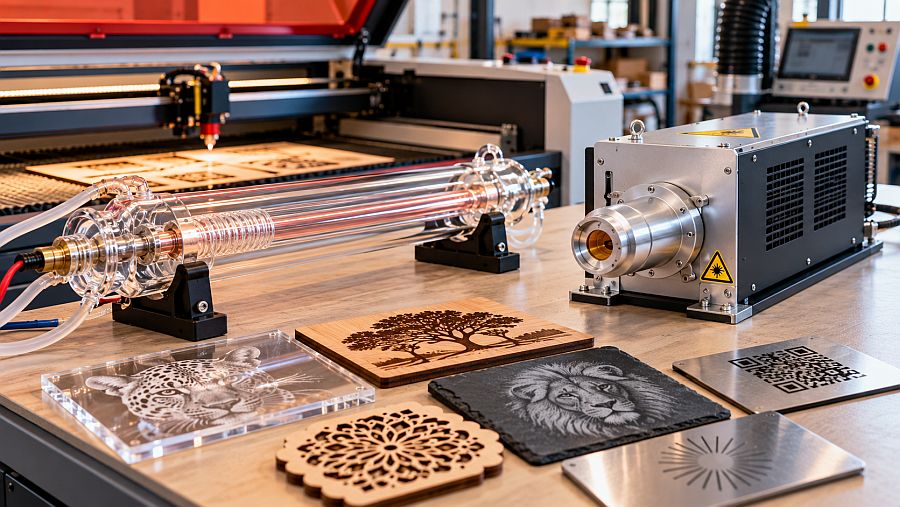
CO₂ laser cutting and engraving machines are available with several different laser source technologies. Two of the most widely encountered are traditional glass tubes excited by direct current (DC) and metal or ceramic laser sources excited by radio frequency (RF) energy.
Both technologies are capable of producing excellent results, but their operating characteristics, purchase costs and maintenance requirements can differ substantially.
Understanding these differences can help businesses select equipment that suits their applications, production expectations and budgets.
How Does a CO₂ Laser Work?
A CO₂ laser generates an infrared laser beam using an electrically excited gas mixture containing carbon dioxide.
The laser energy is produced within an optical resonator and directed through the machine’s optical system towards the material being processed. In conventional CO₂ cutting and engraving equipment, the beam is commonly delivered through mirrors and focused using a lens.
The fundamental laser technology is similar whether the source is constructed from glass, metal or ceramic.
The important distinction is how the gas is excited and how the laser source is constructed and cooled.
It is also worth clarifying a common misconception: an RF-excited CO₂ laser is not a solid-state laser. It remains a gas laser. The term solid-state properly describes technologies in which the laser’s gain medium is a solid material, rather than a gas.
Glass DC Laser Tubes
Glass CO₂ laser tubes are widely used in cutting and engraving equipment, particularly where affordability and practical cutting capability are important.
These sources typically use a high-voltage DC electrical supply to excite the gas mixture within a sealed glass enclosure. Most conventional glass DC tubes require liquid cooling, with water circulating through the tube’s cooling jacket. The cooling system must maintain suitable operating temperatures and adequate flow to prevent overheating.
Glass tubes are available across a range of power ratings and are commonly used for cutting and engraving wood, acrylic, leather, paper, cardboard and other compatible non-metallic materials. Their relatively accessible purchase and replacement costs make them attractive to small businesses, educational facilities and commercial workshops.
However, their performance and longevity depend on appropriate cooling, electrical operating conditions, maintenance and the quality of the tube itself.
Metal RF Laser Sources
RF CO₂ laser sources use radio-frequency electrical energy to excite the laser gas.
Rather than relying on the same high-voltage DC discharge arrangement used in conventional glass tubes, RF systems employ a high-frequency excitation method. These sources are often manufactured using metal or ceramic structures and may incorporate compact resonator designs.
RF excitation can provide particularly responsive control of laser output, making it attractive for applications requiring rapid modulation, fine engraving detail and precise marking. Many compact RF sources are air-cooled, although cooling arrangements vary by manufacturer, construction and output power. Some require liquid cooling.
RF sources generally involve a higher initial investment than conventional glass DC tubes. For certain applications, however, their modulation characteristics, compact construction and potential service life can justify that additional cost.
Engraving Quality and Beam Characteristics
One of the most frequently discussed differences between glass DC and metal RF lasers concerns engraving quality.
RF laser sources are often associated with good beam characteristics and rapid modulation, both of which can be advantageous when producing detailed graphics, small text and fine markings. However, it would be misleading to suggest that every RF source produces a better beam than every glass tube.
Beam quality depends on the laser source’s optical design, operating condition and manufacturing quality. The complete machine also plays a substantial role. Motion-system accuracy, controller performance, optical alignment, focusing arrangements and engraving parameters all influence the final result.
A well-configured glass-tube machine can produce excellent engraving results, while an RF source installed in a poorly designed machine cannot compensate for inadequate mechanical or optical performance.
The quality of the finished product depends on the complete laser system, not simply the type of laser source.
Modulation and Engraving Speed
Modulation describes the ability to control the laser’s output, including switching or varying its power during operation. RF laser sources can offer particularly fast and precise modulation.
This can be advantageous when engraving detailed graphics, reproducing fine tonal variations or performing applications involving rapid changes in laser output.
Conventional glass DC systems generally have different response characteristics, influenced by the tube and its power supply. However, this does not mean that glass-tube machines are inherently unsuitable for high-quality engraving. For many commercial applications, their performance is entirely adequate.
It is also important to distinguish between laser modulation speed and the maximum movement speed advertised for a machine. A machine capable of rapid movement will not necessarily produce acceptable results at its maximum specified speed.
Practical engraving performance depends on the interaction between the laser source, controller, mechanical system, material and required finish.
Cutting Performance
Both glass DC and RF CO₂ lasers can cut suitable non-metallic materials effectively.
The most appropriate choice depends on the material, thickness, required edge quality and production speed. For many general-purpose cutting applications, glass DC laser systems offer excellent value.
Their availability across a broad range of power ratings makes them particularly useful for businesses cutting acrylic, plywood, MDF and similar materials.
RF sources can also provide excellent cutting performance, particularly where their specific beam characteristics or modulation capabilities offer advantages. However, the presence of an RF source does not automatically mean that a machine will cut thicker material or operate faster. Cutting capability depends on usable optical power, beam characteristics, focusing, air assistance, material properties and the machine’s overall configuration.
Buyers should therefore evaluate cutting performance using representative materials and realistic production requirements.
Cooling Requirements
Cooling is essential to the reliable operation of CO₂ laser equipment.
Conventional glass DC tubes generally require water cooling. Depending on the machine and operating environment, this may involve a suitable recirculating cooling system or a dedicated temperature-controlled chiller.
Correct cooling is particularly important in South African workshops where ambient temperatures can become high during summer. Excessive tube temperatures can reduce performance and contribute to premature deterioration.
RF sources may use air cooling, liquid cooling or other arrangements specified by the manufacturer. An air-cooled RF source can simplify installation by eliminating the need for a separate water-cooling circuit for the laser source. However, air cooling still requires adequate ventilation, suitable ambient conditions and maintenance of cooling fans or heat-transfer surfaces.
Neither technology should be operated outside its specified temperature or cooling requirements.
Service Life and Maintenance
Laser source longevity is an important consideration, but it is also an area where buyers frequently encounter overly optimistic claims.
Some manufacturers advertise RF source lifetimes extending into tens of thousands of operating hours.
Glass DC tubes are often associated with shorter expected service lives.
These figures should not be treated as universal guarantees. Actual service life depends on the source design, manufacturing quality, operating power, cooling conditions, environment and usage patterns. A laser source may also experience a gradual reduction in available output power rather than failing suddenly.
For this reason, buyers should distinguish between advertised operating life, expected useful service life and the warranty actually provided.
Maintenance requirements also differ.
Glass DC systems require attention to cooling arrangements, optical alignment and the condition of the laser tube and associated components.
RF sources may reduce some of these requirements, but they are not maintenance-free.
The complete machine still requires inspection and maintenance of its optics, motion system, extraction equipment and other components.
Replacement Costs and Technical Support
The initial purchase price is only part of the financial comparison.
Glass DC tubes are generally less expensive to replace and are widely available for many common machine configurations.
RF sources typically cost more and may require specialised servicing or replacement arrangements.
Some RF source designs can be refurbished or serviced by specialist providers, but this depends on the manufacturer and model. Availability of local technical support is therefore an important consideration.
Before purchasing equipment, businesses should establish whether replacement sources and associated components are readily obtainable, what servicing arrangements are available and how long repairs may take.
For a workshop relying on a single laser machine, the financial consequences of extended downtime can be considerable. This is why laser source selection should form part of a broader Total Cost of Ownership assessment rather than being treated as an isolated technical decision.
Which Technology Is Right for Your Business?
There is no single answer that applies to every laser user.
A glass DC system may be an excellent choice for a business that primarily cuts acrylic, plywood or other compatible materials and requires dependable production capability at an accessible purchase price. It may also be entirely suitable for engraving applications where the required detail and production speed fall comfortably within the machine’s capabilities.
An RF system may be particularly attractive where rapid modulation, fine engraving detail, compact source construction or specific production requirements justify the additional investment.
For businesses considering either technology, the most useful approach is to compare complete machines performing the work they will actually be required to do. This means considering the materials, finished-product quality, operating hours, maintenance requirements, replacement costs and available technical support.
Where possible, practical demonstrations should use representative customer designs and materials rather than relying exclusively on advertised specifications.
The Right Laser for the Right Application
Glass DC and metal RF CO₂ laser technologies have different strengths, but neither should be judged solely by its construction or purchase price.
RF technology can offer important advantages in modulation and particular precision applications.
Glass DC technology remains a practical and commercially valuable solution for a wide range of cutting and engraving requirements.
The quality of the laser source matters, but so does the engineering of the complete machine.
At Perfect Laser Technologies, we believe that selecting the correct equipment begins with understanding what the customer needs to produce, how frequently the machine will operate and what level of performance the application requires.
The best laser is not necessarily the one with the most expensive source. It is the one that delivers the required results reliably, efficiently and economically.