
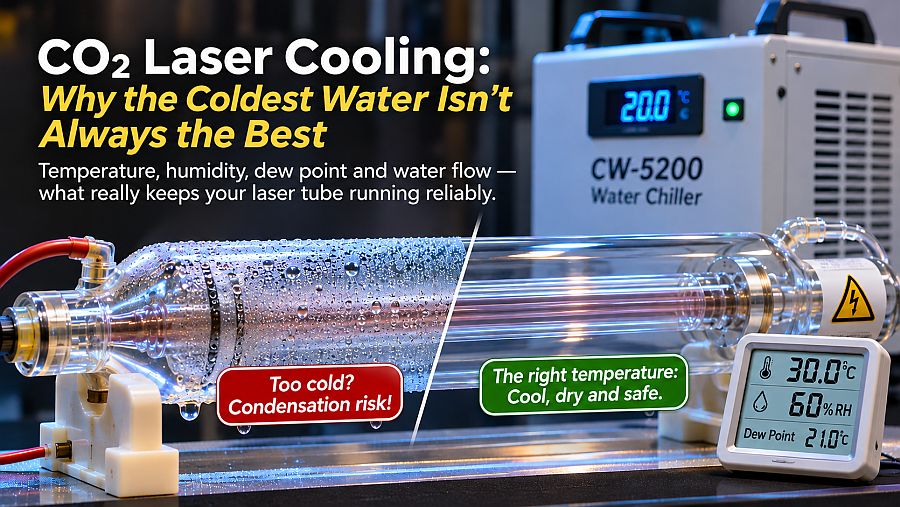
A glass CO₂ laser tube needs effective cooling, particularly during hot weather. But setting the water chiller to its lowest possible temperature can introduce problems of its own. Understanding the relationship between water temperature, humidity, condensation and cooling capacity is essential to protecting the laser tube.
The Question Every Laser Operator Eventually Asks
It’s a hot summer afternoon. The workshop temperature is approaching 30°C, the CO₂ laser has been cutting for several hours, and the operator is concerned about the temperature of the glass laser tube. The obvious solution seems simple: turn down the chiller. If 22°C is good, surely 18°C must be better?
Not necessarily. A glass CO₂ laser tube must operate within an appropriate temperature range, but colder cooling water does not automatically mean better performance or longer tube life. In fact, excessively cold water can create a problem that is potentially just as serious as overheating: condensation.
The challenge is to remove enough heat to protect the laser tube while avoiding conditions that allow moisture to collect on its external surfaces and nearby components. To understand why this matters, we first need to look at what the cooling system actually does.
Why Glass CO₂ Laser Tubes Need Water Cooling
A glass CO₂ laser tube converts electrical energy into laser radiation through a gas discharge. However, the conversion is not particularly efficient. Only a portion of the electrical energy supplied to the tube emerges as useful laser output. Much of the remaining energy becomes heat.
That heat must be removed to maintain stable operating conditions. An 80 W laser tube, for example, is rated in terms of optical output. It does not consume only 80 W of electrical power. The actual electrical input and resulting heat load depend on the tube design, operating current and efficiency. This distinction is important when selecting cooling equipment.
A cooling system must deal with the heat generated during operation, not merely the optical wattage printed on the tube’s label. Excessive tube temperature can affect laser output, discharge conditions and the service life of the tube. The purpose of water cooling is therefore to maintain a controlled operating temperature by continuously transferring heat away from the tube. But moving water and cooling water are not necessarily the same thing.
Water Pumps, Coolers and Refrigerated Chillers
These three terms are frequently used interchangeably, even though they describe different functions.
A Water Pump Circulates Water
A basic water pump moves water through the laser tube and back to a reservoir. The circulating water absorbs heat from the tube and carries it into the reservoir. However, the pump does not actively refrigerate the water.
Heat must eventually escape from the reservoir to the surrounding environment. If the rate of heat entering the water exceeds the rate at which the system can reject it, the water temperature will continue to rise. A larger reservoir may slow the temperature increase, but it does not eliminate the heat being generated.
An Ambient-Air Cooler Rejects Heat
Some systems combine water circulation with a fan and heat exchanger. These devices are often marketed as industrial water chillers, even when they contain no refrigeration compressor. Their function is more accurately described as ambient-air cooling.
The heat exchanger transfers heat from the circulating water to the surrounding air. This is useful, but it has a fundamental limitation. An ordinary air-cooled heat exchanger cannot continuously maintain water below the temperature of the air used to cool it.
As the surrounding air becomes hotter, the system’s ability to maintain a sufficiently low water temperature becomes more limited. A device that performs adequately during a cool morning may struggle during a hot afternoon.
A Refrigerated Chiller Actively Removes Heat
A compressor-based water chiller operates differently. It uses a refrigeration system to remove heat from the circulating water and reject that heat to the surrounding environment.
This allows it to maintain a controlled water temperature below ambient temperature, provided it has sufficient cooling capacity and operates within its specified conditions.
A refrigerated chiller also introduces the possibility of condensation if the water is cooled too far below the dew point of the surrounding air. That is where temperature control becomes particularly important.
The CW-3000 Problem: When a Chiller Isn’t Actually a Chiller
A familiar example in the CO₂ laser industry is the CW-3000-type water cooler. Although commonly advertised as an industrial chiller, the conventional CW-3000 design does not use compressor-based refrigeration. It circulates water through a heat exchanger cooled by ambient air.
This makes it fundamentally different from a refrigerated chiller such as a CW-5200-type unit. The distinction is not simply a matter of terminology. In a workshop where ambient temperature is already high, an ambient-air cooler has limited ability to maintain water at a temperature suitable for a continuously operating laser tube.
The equipment may circulate water perfectly well while the water temperature gradually rises. This is why operators should look beyond the word chiller and establish how the equipment actually removes heat.
For glass CO₂ laser tubes in the 80–150 W range, particularly under South African summer conditions, properly sized refrigerated cooling is generally the more appropriate approach. The final selection must still be based on the tube manufacturer’s requirements, actual heat load, duty cycle and the chiller’s rated cooling performance.
Is Your Laser Tube Getting Sweaty?
Condensation is a familiar phenomenon. Take a cold bottle of water out of the refrigerator on a humid day and leave it on a table. Before long, droplets appear on the outside. The water hasn’t leaked through the bottle. Moisture from the surrounding air has condensed onto its cold surface.
The same thing can happen to a glass CO₂ laser tube. The important factor is the dew point.
Dew point is the temperature at which air, at its existing moisture content and pressure, becomes saturated when cooled. If an exposed surface falls below the dew point of the surrounding air, moisture can condense onto it.
A water-cooled laser tube may have external surfaces sufficiently close to the cooling-water temperature for condensation to become a concern. And because the tube operates at very high voltage, moisture is considerably more serious than a few harmless droplets on a cold drink.
Why Condensation Is Dangerous
Glass CO₂ laser tubes typically operate with high-voltage electrical connections. Moisture accumulating around the tube, its electrical connections or nearby insulating surfaces can increase the risk of electrical tracking and arcing. Arcing can damage the tube and associated high-voltage components.
Condensation may also affect optical and mechanical components inside the laser enclosure. Moisture on optical surfaces can attract contamination and interfere with normal operation. Exposing contaminated or wet optics to an intense laser beam can cause damage. The risk is not limited to the tube itself. Electrical equipment, connectors and other components may also be affected by excessive moisture.
If condensation is visible on the tube or around its high-voltage connections, laser operation should stop immediately.
The cause must be identified and corrected before the laser is returned to service. High-voltage components must not be touched or wiped while energised, and any suspected electrical damage requires appropriate inspection by a qualified technician.
Why 20°C Is Not a Universal Answer
Operators frequently encounter advice suggesting that CO₂ laser cooling water should be maintained at 20°C.
That may be a suitable operating temperature for certain tubes under appropriate environmental conditions. But it is not a universal setting. The correct water temperature depends on the manufacturer’s specified operating range and the conditions in which the machine is installed.
Consider two workshops, both at an ambient temperature of 30°C. One has relatively dry air. The other has high humidity. Although their air temperatures are identical, their dew points are very different.
| Workshop conditions | Approximate dew point |
|---|---|
| 30°C at 40% relative humidity | 15°C |
| 30°C at 60% relative humidity | 21°C |
| 30°C at 80% relative humidity | 26°C |
In the first workshop, a surface at 20°C would ordinarily be above the dew point. In the second, that same surface could fall below the dew point, creating a condensation risk. In the third, the risk would be substantially greater. The important lesson is that ambient temperature alone does not determine whether condensation will occur.
Relative humidity must also be considered. A temperature setting that works well in a dry inland workshop may be unsuitable in a humid coastal environment.
Why the Five-Degree Rule Can Be Misleading
A commonly repeated recommendation is to keep cooling water no more than 5°C below room temperature. Although this may be intended as a practical precaution, it is not a reliable substitute for understanding dew point. At low relative humidity, a temperature difference greater than 5°C may not create condensation.
At high relative humidity, condensation can occur with a temperature difference smaller than 5°C. For example, air at 30°C and 80% relative humidity has a dew point of approximately 26°C. A surface at 25°C could therefore develop condensation despite being only 5°C below ambient temperature.
The scientifically meaningful comparison is between the temperature of exposed surfaces and the dew point of the surrounding air. A sensible operating margin should also allow for measurement uncertainty, temperature fluctuations and differences between water temperature and the actual surface temperature of the tube. The correct margin is not necessarily identical for every installation.
Intelligent Mode Versus Constant-Temperature Mode
Many industrial water chillers offer different temperature-control modes. The terminology varies between manufacturers, but two common approaches are intelligent or ambient-following control and constant-temperature control.
Intelligent or Ambient-Following Control
In this mode, the controller adjusts its water-temperature target in relation to the measured ambient temperature. The intention is often to reduce the temperature difference between the cooling water and the surrounding air. This can help manage condensation risk.
However, the actual relationship between ambient temperature and the target water temperature depends on the controller’s configuration. It should not be assumed that every chiller uses the same offset or control logic.
There is also an important limitation. If ambient temperature rises substantially, an ambient-following controller may permit the water temperature to rise beyond the preferred operating range of a particular laser tube.
Constant-Temperature Control
In constant-temperature mode, the operator selects a fixed target water temperature. The chiller attempts to maintain that target regardless of changes in ambient temperature, subject to its available cooling capacity.
This can be useful where the workshop environment is controlled and the selected temperature is appropriate for the laser tube. But a fixed setting does not automatically protect against condensation. If humidity increases sufficiently, the dew point may rise above the temperature of exposed surfaces. A previously acceptable setting can then become problematic.
Which Mode Is Better?
Neither mode is automatically superior. The appropriate choice depends on the laser tube’s permitted temperature range, the controller’s behaviour and the workshop environment.
In a properly controlled room, a suitable constant-temperature setting may provide stable operation. In other circumstances, an appropriately configured ambient-following mode may help reduce condensation risk.
But if the workshop is so hot and humid that the tube cannot be kept within its required temperature range without creating condensation, changing control modes is not a complete solution. The operating environment must be addressed.
Why Air Conditioning Can Be Part of the Cooling Solution
A refrigerated chiller controls the temperature of the circulating water. It does not necessarily control the temperature or humidity of the air surrounding the laser tube. This distinction becomes important in hot, humid workshops. Air conditioning can help by reducing room temperature and, when properly sized and operated, removing moisture from the air.
Reducing humidity lowers the dew point. That can make it possible to maintain the cooling water within the tube manufacturer’s required range without producing condensation on exposed surfaces.
A dehumidifier may also be useful where moisture control is the primary concern. However, environmental control must be considered as a complete system. A chiller returns heat into the room unless its condenser heat is exhausted elsewhere.
Poor ventilation or inadequate air-conditioning capacity can therefore contribute to rising workshop temperatures. Simply installing a larger refrigerated chiller does not solve a poorly controlled workshop environment.
Cooling Capacity Is Not the Same as Laser Power
Another common mistake is to select a chiller using only the optical wattage of the laser tube. An 80 W laser does not necessarily require a chiller rated at 80 W of cooling capacity. The cooling equipment must remove the actual heat load generated by the tube and associated cooling circuit.
This depends on electrical input, conversion efficiency, operating current and duty cycle. Chiller specifications also require careful interpretation. Cooling capacity is commonly expressed in watts or another unit of thermal power. But the stated capacity may apply only under particular ambient and water-temperature conditions.
A chiller that provides adequate cooling in a 25°C room may deliver less effective cooling in a substantially hotter environment. The manufacturer’s performance data should therefore be checked against the intended operating conditions. The number of water ports is not a substitute for cooling-capacity information either. A dual-circuit arrangement does not automatically provide twice the refrigeration capacity of a single-circuit arrangement.
Water Flow Matters — But More Is Not Always Better
Cooling requires water to circulate through the laser tube at an adequate rate. If water flow is insufficient, heat may not be removed effectively. Restricted flow can result from kinked hoses, blockages, trapped air, pump problems or incorrectly connected plumbing.
However, simply installing the largest available pump is not necessarily the correct solution. The cooling circuit has its own hydraulic characteristics. Flow rate depends on pump performance, tubing dimensions, restrictions and pressure losses throughout the system. Excessive pressure may also be inappropriate for components designed for a particular operating range. The objective is to provide the flow required by the tube and cooling-system manufacturers.
Why Flow Protection Is Essential
A water-flow protection system can prevent laser operation when adequate circulation is not established. This is an important protective function. A tube can be damaged rapidly if the laser continues operating without sufficient cooling water. A flow alarm should therefore be treated as a reason to stop laser operation and investigate the problem.
It should never be regarded as an inconvenience to be bypassed. Likewise, a flow indicator confirms only the condition it is designed to monitor. Adequate flow does not guarantee that the water temperature is correct.
Both circulation and temperature control must be maintained.
Water Quality and Cooling-System Maintenance
A refrigerated chiller may appear to require little attention, but its performance depends on routine maintenance.
Cooling Water
The cooling water must meet the requirements of the tube and chiller manufacturers. Contaminated water can contribute to deposits, biological growth, reduced heat-transfer performance and other problems.
The correct water specification, replacement interval and any permitted additives should be taken from current equipment documentation. Unapproved chemicals should not be added to the cooling circuit. A cleaning chemical that is suitable for one system may damage seals, tubing, pumps or other components in another.
Airflow and Filters
Air-cooled chillers reject heat through a condenser. If the condenser or its air filters become blocked with dust, the chiller’s ability to reject heat is reduced. This can lead to poor cooling performance, higher operating temperatures or protective shutdowns.
Adequate clearance around ventilation openings is essential. The manufacturer’s maintenance instructions should determine cleaning intervals and procedures.
Hoses and Connections
Cooling hoses should be inspected for leaks, kinks, deterioration and insecure connections. Air trapped in the cooling circuit can interfere with circulation. Water levels should be checked as specified by the equipment manufacturer.
Any unexpected loss of water should be investigated rather than repeatedly corrected by topping up the reservoir.
Alarms and Interlocks
Temperature alarms, flow alarms and other protective functions must remain operational. Alarm codes are not universal. An error code on one controller may have a different meaning on another.
Operators should consult the correct documentation rather than relying on instructions intended for a different model or controller version.
What Should You Do During a Heatwave?
When workshop temperatures rise, the correct response is not simply to reduce the chiller setpoint. A more useful approach is to check the complete operating situation.
First, establish the temperature range specified for the laser tube. Then measure the actual room temperature and relative humidity. These measurements can be used to estimate the dew point and assess whether the intended cooling-water temperature presents a condensation risk.
Check that the chiller is operating within its rated ambient conditions and has adequate cooling capacity. Ensure that airflow is unobstructed, filters are clean and water circulation is normal. Inspect the tube compartment for signs of moisture or leakage.
If the system cannot maintain an acceptable water temperature without creating condensation, reduce the heat and humidity in the workshop before continuing operation. Where necessary, suspend laser operation until suitable conditions can be restored. A few minutes spent investigating the environment is preferable to damaging a laser tube or its high-voltage equipment.
The Most Important Temperature Is the Correct One
Glass CO₂ laser tubes require effective, reliable cooling. Too little cooling can result in excessive operating temperatures, reduced performance and premature tube failure. But excessive cooling introduces another risk.
When exposed surfaces fall below the dew point of the surrounding air, condensation can form. In equipment operating at high voltage, that moisture can have serious consequences.
The solution is not to choose the coldest possible water temperature. It is to maintain the manufacturer’s required operating conditions while accounting for ambient temperature, humidity, water flow and cooling capacity.
A properly selected refrigerated chiller is an important part of that process, but it cannot compensate for every environmental problem.
Good CO₂ laser cooling is not about making the water as cold as possible. It is about keeping the laser tube at the right temperature, under the right conditions, throughout its operation.
