
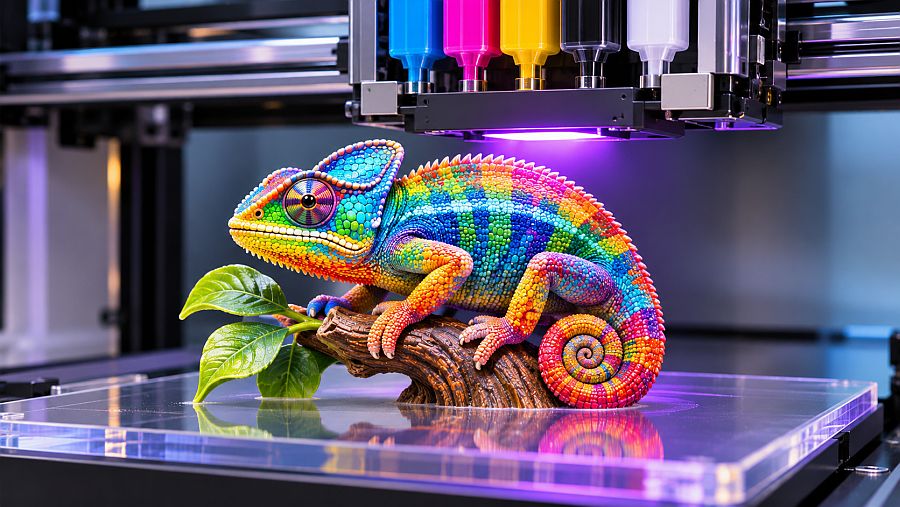
3D printing is often associated with plastic filament, visible layers and objects produced in a single colour. But a different approach uses inkjet technology, liquid photopolymers and ultraviolet light to create detailed three-dimensional objects with complex colour and surface characteristics.
From Printing Objects to Printing Their Appearance
For many people, the familiar image of a 3D printer is a machine feeding plastic filament through a heated nozzle. The nozzle moves across a build platform, depositing molten material in successive layers until a physical object emerges.
This process, commonly known as Fused Deposition Modelling (FDM) or Fused Filament Fabrication (FFF), has made additive manufacturing accessible to businesses, educational institutions and hobbyists. It is relatively straightforward, supports a wide variety of thermoplastic materials and can produce genuinely useful components.
But what happens when the objective is not simply to reproduce an object’s shape? What if its colour, fine surface detail and visual appearance are equally important?
This is where full-colour material jetting introduces a fundamentally different approach. Instead of pushing molten filament through a nozzle, certain 3D printing systems use printheads to deposit microscopic droplets of liquid material, building and curing the object one layer at a time.
The result can be a highly detailed three-dimensional model whose colours are created during manufacture rather than applied afterwards. The distinction is important: the printer is no longer concerned only with geometry. It is also helping to manufacture the object’s appearance.
What Is Material Jetting?
Material jetting is one of the recognised categories of additive manufacturing. The underlying principle is the selective deposition of droplets of build material.
In photopolymer-based systems, printheads deposit precisely controlled quantities of liquid resin onto a build platform. The deposited material is then cured using ultraviolet light. This process is repeated layer by layer until the complete object has been formed. The concept shares some characteristics with conventional inkjet printing.
A two-dimensional inkjet printer places tiny droplets of ink onto paper or another substrate. A material-jetting 3D printer similarly controls the placement of droplets, but those droplets contribute to the construction of a solid object. Rather than creating a single printed surface, the machine builds thousands of closely controlled cross-sections.
The process may also involve multiple build materials, coloured materials and temporary support materials. These capabilities allow material jetting to produce shapes and visual effects that would be difficult to achieve using conventional single-material filament printing.
How a Full-Colour Object Is Built
The process begins with a digital three-dimensional model. Unlike a basic model containing only geometric information, a full-colour model must also communicate how its appearance should be reproduced.
Depending on the system, this information may include surface colours, textures, material assignments and other visual properties. Specialised preparation software processes the model and divides it into thin horizontal layers.
For each layer, the software determines where build material, coloured material and any necessary support material should be deposited. The printheads then dispense droplets at the required positions.
In a UV-curable system, ultraviolet exposure causes the deposited photopolymer material to harden. Once a layer has been formed, the printer progresses to the next layer. The operation continues until the entire object is complete.
Although the principle sounds straightforward, the process requires close coordination between the printheads, material delivery system, curing equipment, build platform and software. Small variations in droplet placement, material behaviour or curing can influence the finished result. This makes full-colour material jetting as much a problem of precision manufacturing as it is a printing process.
Why CMYK Matters in Three Dimensions
Anyone familiar with digital colour printing will recognise the letters CMYK.
They represent cyan, magenta, yellow and black — the colour components commonly used to reproduce images through subtractive colour mixing.
In conventional printing, carefully controlled combinations of these inks create the appearance of a much wider range of colours. Full-colour 3D material-jetting systems can apply related principles, using coloured materials to reproduce the desired appearance of an object.
However, three-dimensional colour reproduction introduces complications that do not arise in quite the same way on a sheet of paper. Light interacts with the surface and, depending on the material, may penetrate beneath it. The optical properties of the cured photopolymer influence how colours are perceived. Opacity, translucency, surface texture and the arrangement of coloured material can all affect the result.
White material can be especially important. In two-dimensional printing, the white paper often provides the reflective background against which coloured inks are viewed. A three-dimensional object has no equivalent built-in white substrate.
White or opaque build material may therefore be needed to establish a suitable optical background and control how colours appear. This is one reason why the architecture of a full-colour material-jetting system can involve more than the four familiar CMYK channels.
Does Full-Colour Mean Millions of Accurate Colours?
Manufacturers sometimes advertise the ability to reproduce millions of colours.
Such claims may describe the number of digitally addressable colour combinations or the capabilities of a particular colour-generation system. They should not automatically be interpreted as a guarantee that millions of visually distinct colours can be reproduced accurately on every object.
There is a difference between the number of possible digital colour values and the range of colours a physical printing process can produce. That physically reproducible range is known as the colour gamut.
The actual gamut depends on the available materials, their optical properties and the printing process. Colour accuracy introduces another consideration. A colour displayed on a calibrated monitor may not appear identical when reproduced in cured photopolymer.
Colour-management systems, including ICC-based workflows where supported, can help control these differences. But calibration and profiling cannot create colours outside the physical capabilities of the materials.
For applications where colour is critical, the important questions are not simply how many colours the printer claims to produce. They are how accurately, consistently and repeatably it reproduces the colours required for the intended application.
Layer Thickness and Surface Detail
One of the attractions of material jetting is its ability to produce very thin layers. Some systems operate with nominal layer thicknesses measured in tens of micrometres. For perspective, a layer thickness of 20 micrometres is just 0.02 millimetres. Thin layers can help reduce the visible stepping associated with curved or inclined surfaces. However, layer thickness alone does not determine the quality of a finished object.
The size and placement of droplets, curing behaviour, material properties and mechanical accuracy all contribute to the result. The geometry of the object also matters. A finely detailed vertical feature may reproduce differently from a shallow feature on an inclined surface. And a very thin nominal layer does not guarantee that every dimension will be accurate to that thickness.
Resolution, layer thickness, dimensional accuracy and surface finish are related, but they are not interchangeable specifications.
Understanding that distinction is essential when comparing different 3D printing technologies.
The Unsung Role of Support Material
Many three-dimensional objects contain features that cannot be printed directly into empty space.
Overhangs, internal cavities, projecting elements and complex shapes may require temporary support during construction. In filament printing, these supports are often produced using the same thermoplastic as the object or a separate removable material.
Material-jetting systems can employ dedicated support materials that are deposited alongside the build material. These supports help maintain the geometry of the object while it is being manufactured. After printing, they must be removed. Depending on the technology and material system, removal may involve mechanical cleaning, water-based processes or other manufacturer-specified methods.
This stage deserves more attention than it usually receives. Support material consumes resources, adds processing time and can affect delicate features. Complex internal cavities may be difficult to clean completely. Aggressive removal methods can damage fine details, while inadequate cleaning can leave unwanted residue.
A model that appears perfect immediately after printing is not necessarily a finished product. Its post-processing requirements form part of the manufacturing process and must be considered when evaluating productivity.
Material Jetting Is Not Binder Jetting
The terminology surrounding inkjet-based 3D printing can be confusing. Two processes in particular are frequently mistaken for one another: material jetting and binder jetting. Both can use inkjet-style deposition, but they operate differently.
Material jetting deposits droplets of the material that will form the object, such as a liquid photopolymer that is subsequently cured.
Binder jetting, by contrast, deposits a liquid bonding agent onto a bed of powder.
The bonding agent selectively joins powder particles together to form the required geometry. Depending on the materials and process, binder-jetted parts may require additional curing, infiltration or other post-processing. Some binder-jetting systems can also produce coloured models.
Consequently, the description full-colour 3D printing does not identify a single manufacturing technology. Two machines may both produce colourful figurines while relying on fundamentally different materials, processes and finishing methods. That distinction matters when comparing strength, surface finish, colour behaviour and operating costs.
How Does Material Jetting Compare with Other 3D Printing Technologies?
No single additive manufacturing process is ideal for every application. Filament extrusion remains attractive for many practical components because of its accessible equipment, broad thermoplastic selection and relatively straightforward operation.
Vat photopolymerisation technologies, including SLA and DLP, can produce highly detailed objects by curing liquid resin. Material jetting offers another combination of capabilities, particularly where fine detail, complex geometry and controlled visual appearance are important.
| Technology | Basic process | Typical strengths | Important considerations |
|---|---|---|---|
| FDM / FFF | Extrudes thermoplastic filament | Accessible, versatile, useful for functional parts | Visible layers, surface finish and colour limitations depend on equipment |
| SLA / DLP | Selectively cures liquid resin in a vat | Fine detail, smooth surfaces | Resin handling, washing, curing and material limitations |
| Material jetting | Deposits droplets of build material, often UV-cured | Fine detail, colour and potentially multiple materials | Material costs, supports, cleaning and process complexity |
| Binder jetting | Deposits binder onto powder | Complex geometries and material-specific applications | Powder handling and often significant post-processing |
These are broad technological characteristics rather than universal performance rankings. The actual capabilities depend on the individual machine, materials and application.
Where Full-Colour Material Jetting Makes Sense
The value of full-colour material jetting becomes clearer when the appearance of an object is central to its purpose.
Product Development and Design Verification
Design teams often need to evaluate more than the physical dimensions of a proposed product. Colour combinations, branding, surface details and the overall visual impression may influence whether a design is accepted. A full-colour model can help communicate these characteristics before conventional manufacturing begins. This may reduce the need for separate painting or decorative finishing during early design reviews.
However, visual fidelity should not be confused with mechanical equivalence to the eventual production material.
Architectural and Presentation Models
Architectural models can contain intricate geometry, coloured surfaces and small details that are difficult to reproduce manually. Full-colour printing can help represent different materials, areas or design features.
The result can be useful for presentations, planning discussions and communication with people who may find technical drawings difficult to interpret.
Figurines, Collectibles and Miniatures
Detailed figures are a particularly visible application of full-colour 3D printing. Facial features, clothing, textures and decorative elements can potentially be incorporated into the printing process.
This reduces some of the manual finishing associated with monochrome printed models. Nevertheless, the durability of fine features and the consistency of colour reproduction remain important practical considerations.
Educational and Medical Visualisation
Physical models can help communicate complex three-dimensional relationships. In education, coloured structures may make anatomical, geological or mechanical concepts easier to understand.
Medical visualisation can also benefit from models that distinguish structures through colour. However, a model intended for clinical decision-making requires appropriate validation of its source data, geometry and intended use. A visually convincing model is not automatically suitable for medical planning or other safety-critical applications.
Industrial Demonstration Models
Engineering teams may use full-colour models to illustrate assemblies, internal features, flow paths or proposed design changes.
These models can be valuable communication tools even when their materials do not match those of the finished engineering product. The key is to understand what the model is intended to demonstrate.
A Visual Prototype Is Not Necessarily a Functional Part
This is perhaps the most important limitation to understand. A 3D printer capable of reproducing intricate geometry and attractive colours does not automatically produce components suitable for demanding mechanical service. Photopolymer materials can have very different properties from injection-moulded engineering thermoplastics.
Their behaviour under sustained load, impact, elevated temperature, ultraviolet exposure and long-term environmental conditions depends on the formulation and curing process. Some specialised material-jetting systems offer materials developed for particular engineering applications.
Others are primarily intended for visual models and presentation prototypes. The distinction cannot be determined from print resolution or colour capability.
A model may look exactly like a production component while behaving quite differently when subjected to mechanical stress. For functional applications, material data and application-specific testing are essential.
The Economics Behind the Colour
The ability to produce a finished-looking model directly from a digital file is attractive. But the purchase price of the printer is only one part of the economic picture.
Material-jetting systems may require multiple consumables, including coloured build materials, white or opaque materials and support materials. Some material is consumed in support structures rather than in the finished object. Additional material may be used during maintenance, cleaning and printhead servicing.
Printing time is another consideration.
A highly detailed object can require thousands of layers, and total production time depends on the geometry, selected quality settings and equipment. Post-processing adds labour and may require dedicated facilities or equipment.
The effective cost per finished model should therefore account for material consumption, support removal, failed builds, maintenance, equipment utilisation and operator time. A machine that produces impressive samples is not necessarily economical for every production volume.
Conversely, a more expensive process may be justified where it replaces substantial manual painting, assembly or finishing. The appropriate comparison is the cost and suitability of the complete finished model, not simply the amount of material used to print it.
The Importance of Printheads and Material Compatibility
Material jetting places considerable demands on its printheads. The machine must deliver droplets consistently while handling materials that may differ in viscosity, surface tension and curing behaviour. Printhead technology, waveform control, temperature management and material delivery can all influence reliable deposition.
The build materials must also be compatible with the printhead and curing system. This is an important difference from assuming that a familiar inkjet printhead can automatically handle any UV-curable resin.
Materials designed for conventional flatbed UV printing are not necessarily suitable for manufacturing three-dimensional objects. The required mechanical properties, curing characteristics and layer-to-layer bonding behaviour may be different.
Printhead specifications are therefore only one part of a much larger system design. Reliable material jetting depends on the interaction between hardware, software, chemistry and process control.
Is Full-Colour Material Jetting Changing Manufacturing?
In some applications, undoubtedly. It allows designers and manufacturers to combine geometry and visual information in ways that conventional single-colour printing cannot easily reproduce.
It can reduce certain finishing operations, improve design communication and make complex presentation models more accessible. But it would be misleading to suggest that full-colour material jetting is destined to replace filament printing, resin printing or conventional manufacturing.
Its strengths are application-specific.
A workshop producing robust brackets may have little reason to abandon filament-based printing. A design studio producing highly detailed, coloured presentation models may reach a very different conclusion.
And a manufacturer requiring thousands of identical components must still compare additive manufacturing with moulding, machining and other established processes.
The most useful question is not whether material jetting is the most advanced form of 3D printing. It is whether the technology offers the right combination of geometry, appearance, material properties, cost and productivity for a particular task.
Beyond Filament — and Beyond Appearance
The development of full-colour material jetting illustrates how additive manufacturing continues to diversify.
Some technologies prioritise strength and practical component production. Others emphasise speed, dimensional precision, material selection or surface quality.
Full-colour material jetting introduces another dimension: the ability to manufacture an object’s visual characteristics alongside its physical shape.
That opens opportunities in design, education, communication and specialist model production. It also introduces technical challenges involving colour management, photopolymer chemistry, support removal and process economics. The most important development is not simply that 3D printers can now produce colourful objects.
It is that geometry, material placement and visual appearance can increasingly be controlled within a single digital manufacturing process.
Understanding both the possibilities and the limitations is what turns an impressive demonstration into a useful manufacturing decision.
